Intuition behind multiplying two complex numbers

Intuitive Reason behind Multiplication and Division of Complex Numbers

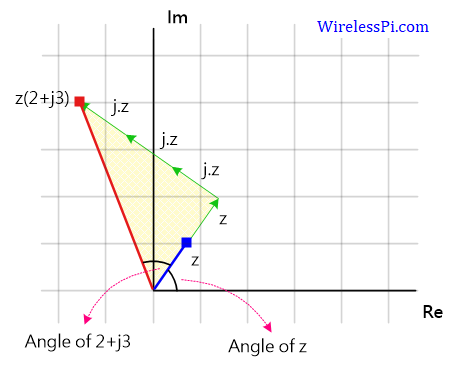
Any introduction to complex numbers and their operations follows a common pattern: the formulas are given without building any intuition. If you have ever wondered about why $j=\sqrt{-1}$, you can read about the origin of complex numbers. In this article, I will explain the intuitive reason behind why a product of two complex numbers multiplies their magnitudes and adds their angles, and a division of two complex numbers divides their magnitudes and subtracts their angles. Let us start with the multiplication. The division scenario can be analogously derived with inverse operations. Multiplication of Complex Numbers The intuition behind multiplying two

Continue reading
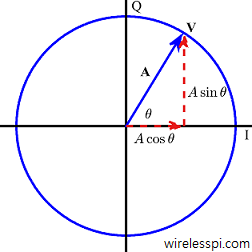
A complex number with its I and Q components

Dealing with Complex Numbers

Although complex notation is not complex to understand, I attempt to avoid complex notation altogether while writing DSP articles. If you are interested in where these complex numbers come from, you can read my real-imaginative guide to complex numbers. A complex number is defined as an ordered pair of real numbers in $(x,y)$-plane. In that respect, complex numbers can be considered as vectors with initial point on the origin $(0,0)$. Addition of complex numbers is then similar to the addition of vectors in $(x,y)$-plane from this perspective. However, multiplication is well defined for complex numbers while it is not defined

Continue reading