I/Q signals as the gateway to DSP

Two Birds with One Tone: I/Q Signals and Fourier Transform – Part 1

When a new member arrives at the Signal Processing Club, this is what they find at the club gate: I/Q signals. Perhaps a secret plot to keep most people out of the party? Some return from here to try another area (e.g., machine learning, which pays more and is easier to understand but less interesting than signal processing). Others persist enough to push the gate open for implementation purposes (even a little understanding is sufficient for this task) but never fully grasp the main idea. So what exactly makes this topic so mysterious? To investigate the answer, we start with

Continue reading
Projections of a sphere in Flatland

Two Birds with One Tone: I/Q Signals and Fourier Transform – Part 2

In Part 1 of I/Q signals series, we saw the implications of orthogonality in amplitude and phase shift. This led to our treatment of signals as two dimensional complex numbers in time I/Q plane. Now we talk about orthogonality in frequency, how it gives rise to a different I/Q plane and see its implications in signal processing applications. Let us start with a new perspective that will lift more veils from the I/Q puzzle. A Basic Building Block Humans use the power of logic to uncover the rules according to which the world works. But our minds struggle to retain

Continue reading
Interaction between populations of rabbits and foxes

Rabbits, Foxes and IQ Signals

If we pay attention, each term in a mathematical equation carries a meaning that resonates with common sense. Today I will explain where Lotka-Volterra equations come from. These equations describe the dynamics of a biological interaction in which a predator (e.g., foxes) and a prey species (e.g., rabbits) engage with each other in a continuous struggle for survival. We will see that the math expressions just line up to describe the phenomenon almost as in words. Moreover, they have a little connection to IQ signals, the fundamental concept in digital signal processing, that will also be presented in the article.

Continue reading
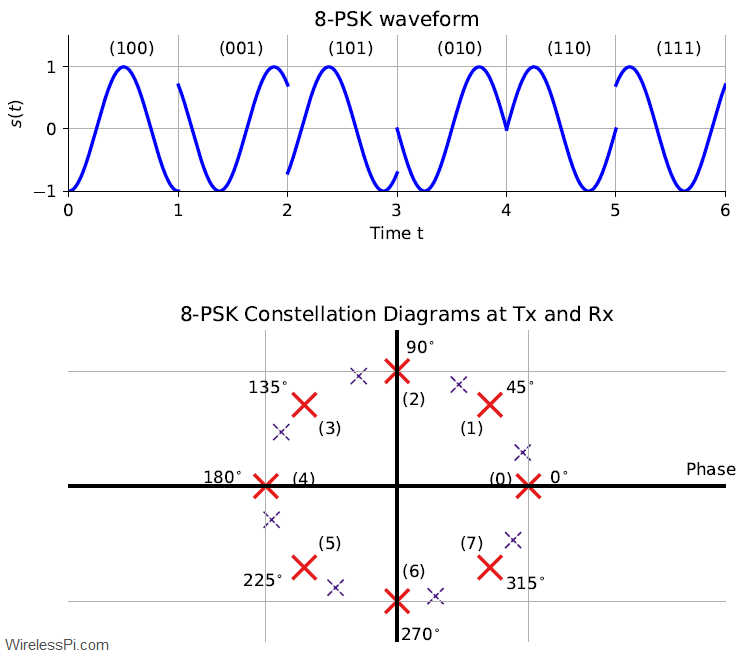
(Top) An 8-PSK waveform. (Bottom) Two constellation diagrams: one at the Tx shown by thick red lines and the other at the Rx for a phase offset of 17 degrees shown by dotted purple lines

I/Q Signals 101: Neither Complex Nor Complicated

Dec 04, 2020 There was a recent discussion on GNU Radio mailing list in regards to the simplest possible intuition behind I/Q signals. Why is I/Q sampling required? Question: The original question from Kristoff went like this: “… when you mention `GNU Radio complex numbers’, you also have to mention I/Q signals, which is a topic that is very difficult to explain in 10 seconds to an audience who has never seen anything about I/Q sampling before.” Comment: According to Jeff Long: “This is a great thing to try to figure out. If we can come up with an answer

Continue reading
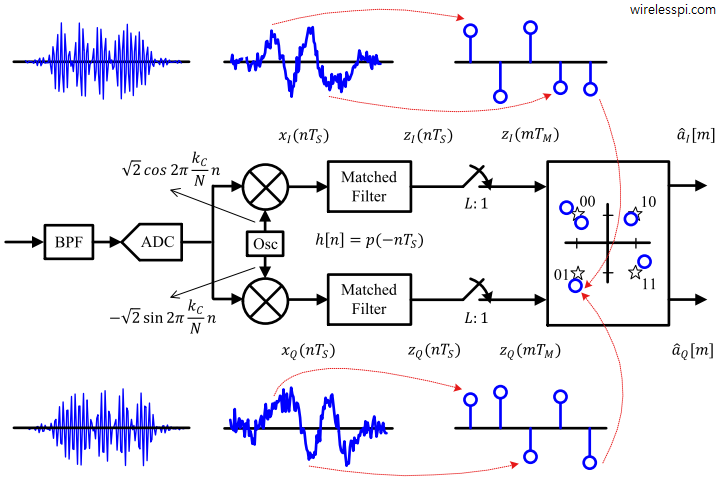
A general QAM detector with respective waveforms at each block

Quadrature Amplitude Modulation (QAM)

Quadrature Amplitude Modulation (QAM) is a spectrally efficient modulation scheme used in most of the high-speed wireless networks today. We discussed earlier that Pulse Amplitude Modulation (PAM) transmits information through amplitude scaling of the pulse $p(nT_S)$ according to the symbol value. To understand QAM, two routes need to be traversed. Route 1 We start the first route with differentiating between baseband and passband signals. A baseband signal has a spectral magnitude that is nonzero only for frequencies around origin ($F=0$) and negligible elsewhere. An example spectral plot for a PAM waveform is shown below for 500 2-PAM symbols shaped by

Continue reading