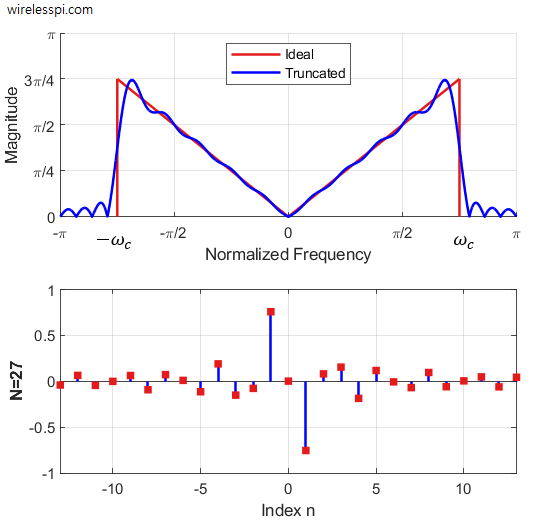
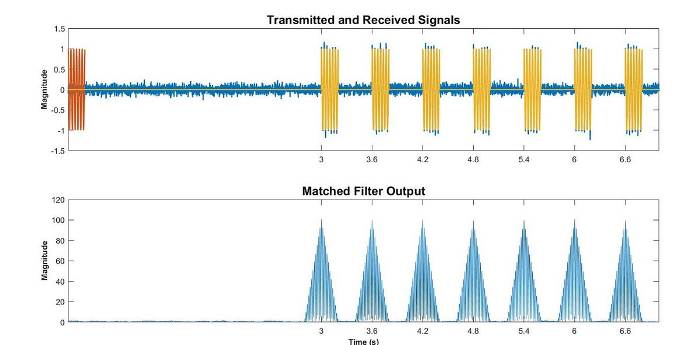
Low pulse width and higher resolution

The Power of Pulse Compression

Human eyes can only see in the visible part of the electromagnetic spectrum. Radar (Radio Detection and Ranging) is a device that extends our ability to detect the environment far beyond what is allowed by the visual nervous system, see the article on Frequency Modulated Continuous-Wave (FMCW) radars. Today we talk about the idea of pulse compression and the role it plays in target detection. As opposed to a Continuous-Wave (CW) radar, a pulsed radar transmits a short burst of energy followed by a period of silence during which it listens for the echo received from the target. As shown

Continue reading
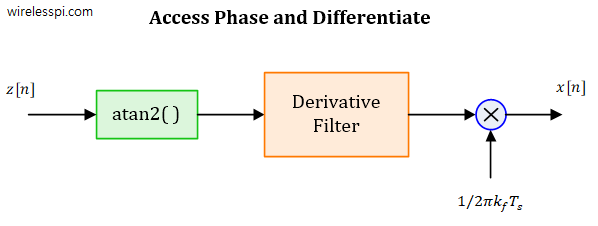
A discrete-time FM demodulator block diagram with atan2 and derivative filter

Frequency Modulation (FM) and Demodulation Using DSP Techniques

Frequency Modulation (FM) is as old as the history of wireless communications itself. The past few decades saw the rise of digital signal processing in all spheres of life that pervaded even the implementation of analog modulation schemes. Today many of the FM systems are built using discrete-time techniques instead of the conventional circuitry as described below. Frequency Modulation In digital communications, data is sent through altering a characteristic of an electromagnetic wave such as amplitude, frequency or phase in discrete steps (e.g., $M$ number of levels). Such systems are known as Amplitude Shift Keying (ASK), Frequency Shift Keying (FSK)

Continue reading