Orange vs tangerine

The Fourier Doppelgangers

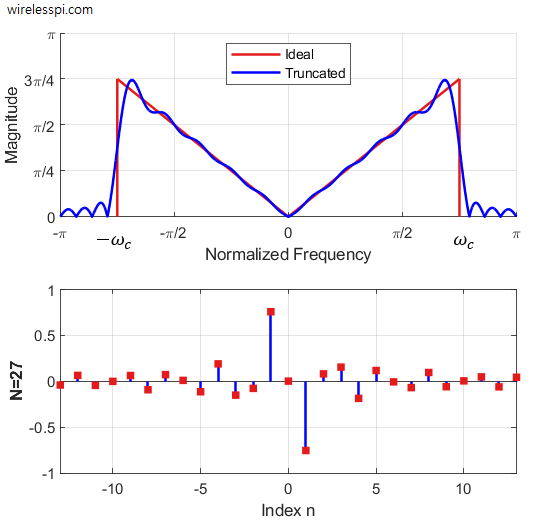
It is well known that Fourier Transform is unique under certain conditions that are satisfied by almost all practical signals. Then, how can we resolve the following contradiction? Consider a sinc pulse and Linear Frequency Modulated (LFM) pulse (a chirp) in time domain. The sinc pulse is defined as \[ \text{sinc}(t) = \frac{sin(\pi t)}{\pi t} \] Now the spectrum of a sinc pulse in time (in an ideal case) is a rectangular signal in frequency domain, which is the most fundamental relation in signal processing. Both the sinc pulse and its spectrum are plotted in the left half of the

Continue reading
Wideband differentiator frequency and impulse responses

Design of a Discrete-Time Differentiator

Many signal processing algorithms require computation of the derivative of a signal in real-time. Some of the examples are timing recovery, carrier frequency synchronization, FM demodulation and demodulation of LoRa signals. An analog or digital filter that computes such a derivative is known as a differentiator. Before we design such a discrete-time differentiating filter, let us review some of the fundamentals. A Derivative The following quote is attributed to Heraclitus, a Greek philosopher, from 535 BC. Change is the only constant in life. This was brought into the realm of science by Newton and Leibniz. The purpose of science is

Continue reading
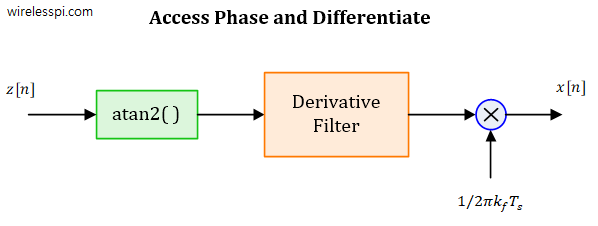
A discrete-time FM demodulator block diagram with atan2 and derivative filter

Frequency Modulation (FM) and Demodulation Using DSP Techniques

Frequency Modulation (FM) is as old as the history of wireless communications itself. The past few decades saw the rise of digital signal processing in all spheres of life that pervaded even the implementation of analog modulation schemes. Today many of the FM systems are built using discrete-time techniques instead of the conventional circuitry as described below. Frequency Modulation In digital communications, data is sent through altering a characteristic of an electromagnetic wave such as amplitude, frequency or phase in discrete steps (e.g., $M$ number of levels). Such systems are known as Amplitude Shift Keying (ASK), Frequency Shift Keying (FSK)

Continue reading
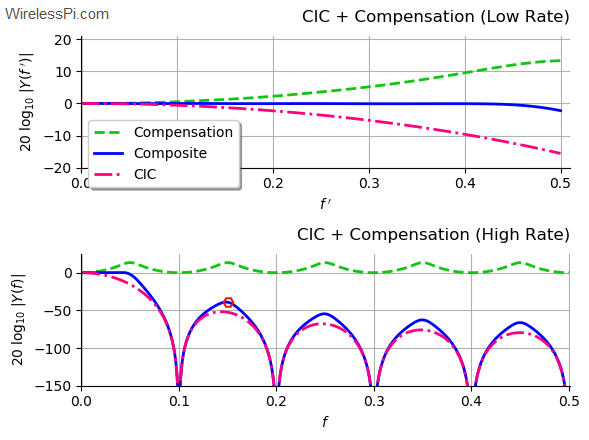
Spectrum of the cascade of CIC filters with a wideband compensation filter for rate change factor 10, unit differential delay and 4 stages

Cascaded Integrator Comb (CIC) Filters – A Staircase of DSP

In olden days, people used to have lots of kids. A famous Urdu satirist once wrote: "It has been observed that the last kid is usually the most mischievous of them all. Therefore, there should be no last kid in a family!" I remembered this line today because I have observed that starting a write-up is the most difficult task of them all. Therefore, there is no introductory paragraph in this article. Suffice it to say that this is the only topic I have found that takes you from a very small first step (just two additions) to really advanced

Continue reading
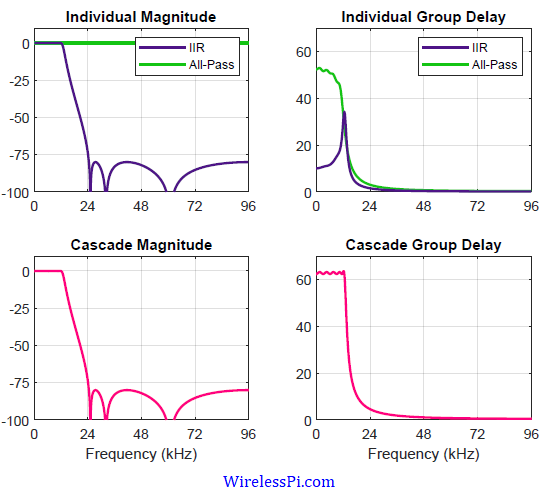
Individual and cascade frequency responses as well as group delays of the IIR and all-pass filters combination

FIR vs IIR Filters – A Practical Comparison

When it comes to practical applications, digital filter design is one of the most important topics in digital signal processing. Today we discuss a critical question encountered in filter design: how to compare the Finite Impulse Response (FIR) and Infinite Impulse Response (IIR) filters. Since there is no clear winner, answering this question enables a designer to choose the right solution for their product. A brief comparison of FIR vs IIR filters is now explained below. Computational Complexity It is well known that most practical signals are simply sums of sinusoids. This implies that signals with sharp transition in time

Continue reading