Theory of relativity and age of planet Earth

The Easiest Tutorial on Kalman Filter

Kalman filter is one of the most important but not so well explained filter in the field of statistical signal processing. As far as its importance is concerned, it has seen a phenomenal rise since its discovery in 1960. One of the major factors behind this is its role of fusing estimates in time and space in an information-rich world. For example, position awareness is not limited to radars and self driving vehicles anymore but instead has become an integral component in proper operation of industrial control, robotics, precision agriculture, drones and augmented reality. Kalman filter plays a major role

Continue reading
Bat echolocation principle

FMCW Radar Part 1 – Ranging

This is Part 1 of a 3-Part series in which we describe how an FMCW radar finds the range of multiple stationary targets. In Part 2, we talk about estimating the velocities of several moving targets and their directions through forming a structure known as the radar cube. Part 3 presents system design guidelines for an FMCW radar. In his book Multirate Signal Processing, Fred Harris mentions a great problem solving technique: "When faced with an unsolvable problem, change it into one you can solve, and solve that one instead." We will see in this article how an FMCW radar

Continue reading
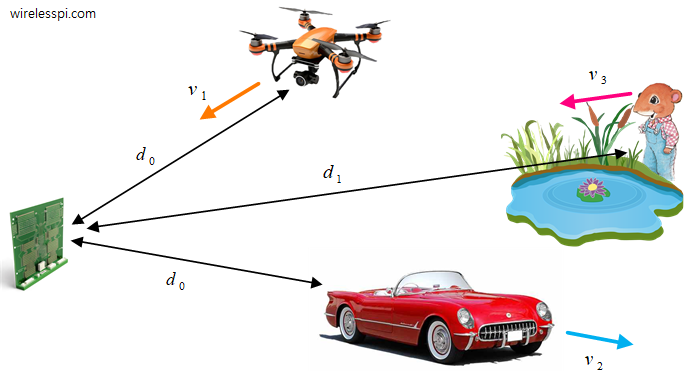
Multiple objects at different speeds for an FMCW radar

FMCW Radar Part 2 – Velocity, Angle and Radar Data Cube

In Part 1 of FMCW radar series, we described how a radar estimates the range of one or more stationary targets. In Part 2, we talk about estimating the velocities of several moving targets and their directions through forming a structure known as the radar cube. Part 3 presents system design guidelines for an FMCW radar. In a wonderful 1991 paper "Wireless Digital Communication: A View Based on Three Lessons Learned", Andrew Viterbi summarizes the Shannon theory for digital communications in the form of 3 lessons, the first of which was the following. "Never discard information prematurely that may be

Continue reading
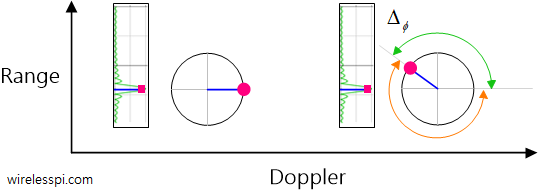
Maximum velocity in an FMCW radar

FMCW Radar Part 3 – Design Guidelines

The Bloom’s Taxonomy describes the levels of mastery one attains in a field. Its last two stages are Synthesis and Evaluation. This is where the masters can be differentiated from the experts. In a job interview, for example, a good technique to judge a candidate’s ability is to ask them where the system in question breaks. A little learning is a dangerous thing Drink deep, or taste not the Pierian spring There shallow draughts intoxicate the brain And drinking largely sobers us again While the first two parts of the FMCW radar series addressed the lower levels, Part 3 is

Continue reading
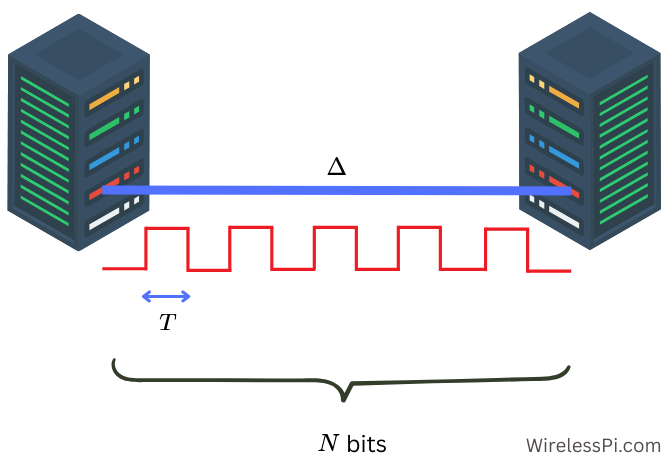
An illustration of bandwidth-delay product

An Intuitive View of Time-Bandwidth Product (TBP)

Time-Bandwidth Product (TBP) of a waveform is a foundational term frequently used in communications and radar community. However, I have never seen any book or online resource explain the core idea in an intuitive manner. Even though I understood the concepts of degrees of freedom and packing of resources in an $N$-dimensional space, I found it hard to come up with a visualization of time-bandwidth product in my head. This is what I set out to accomplish in this article. Let us start with the term Bandwidth-Delay Product (BDP), a term frequently used in communication networks. We will shortly relate

Continue reading